JAMB 2027 Use of English Syllabus: Topics to Read for UTME
Reading for the UTME exam 2027? Use the JAMB 2027 Use of English Syllabus as a checklist for what to read and practice for UTME 2027. Explore JAMB Use of English topics for 2027 preparation, with a revision checklist, study tips and CBT practice. Speaking English every day does not automatically mean you are ready for JAMB Use of English. It is being able to identify a writer’s implied meaning, choose the correct grammatical expression and recognize a word’s stressed syllable under examination pressure.
Preparing for these skills starts with knowing what to read. This JAMB 2027 Use of English syllabus guide gives you a practical topic checklist and a study routine you can follow before UTME.
2027 update: This guide uses the syllabus currently available through JAMB’s official sources. Confirm any changes and the prescribed reading text for your examination year on JAMB IBASS. A separately confirmed 2027 reading-text announcement was not established during this review.
What Topics Should I Read for JAMB Use of English?
JAMB groups the syllabus into Comprehension and Summary, Lexis and Structure, and Oral Forms.
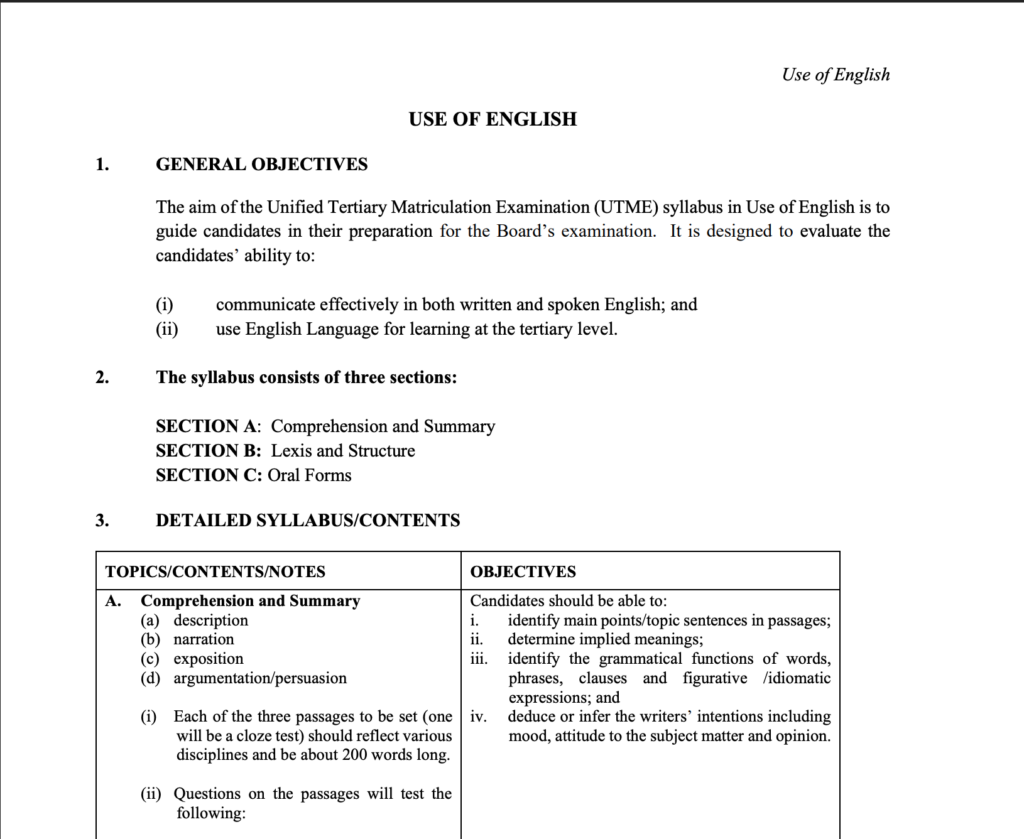
Use the following checklist to organize your preparation:
| Section | Topics to read |
|---|---|
| Comprehension and Summary | Descriptive, narrative, explanatory and argumentative passages; main ideas; implied meanings; vocabulary in context; grammatical functions; logical deductions; writer’s intention and attitude; combining ideas; cloze passages; prescribed reading text. |
| Lexis and Structure | Synonyms and antonyms; clauses and sentence patterns; word classes; mood, tense and aspect; number and concord; comparison; question tags; mechanics, including spelling; ordinary, figurative and idiomatic expressions. |
| Oral Forms | Vowels: monophthongs, diphthongs and triphthongs; consonants and consonant clusters; rhymes and homophones; word stress; emphatic stress. |
These topics follow the published syllabus. Idiomatic expressions should be studied in Standard British English.
JAMB 2027 Use of English Syllabus
SECTION A: Comprehension and Summary
SECTION B: Lexis and Structure
- Positive degree
- Comparative degree
- Superlative degree
SECTION C: Oral Forms
- Monophthongs
- Diphthongs
- Triphthongs
- Consonant sounds
- Consonant clusters
- Voiced consonants
- Voiceless consonants
- Words that rhyme
- Homophones
- Identification of similar sounds
- Monosyllabic word stress
- Polysyllabic word stress
- Primary stress
- Identification of stressed syllables
- Emphatic stress in connected speech
- Identification of stressed words in sentences
- Meaning and interpretation through stress
General Objectives
How to Study Comprehension and Summary
Practise reading for meaning before attempting to read faster. After each paragraph, pause and ask: “What is the writer saying here?”
For your practice sessions:
- Read a short passage and write its main point in one sentence.
- Underline the words that support your answer.
- Separate what the writer states from what you infer.
- Explain unfamiliar expressions using the surrounding sentences.
- Complete cloze exercises, checking both meaning and grammar.
A useful habit is to explain why the other options are wrong. If you cannot explain your choice, revisit the passage before checking the answer.
How to Prepare for Lexis and Structure
Build your revision around examples. Memorising a grammatical rule becomes more useful when you can apply it to a sentence.
Consider this practice question:
Neither the teacher nor the students ___ ready.
A. is
B. are
C. was
D. be
Answer: B. are. With “neither … nor,” the verb normally agrees with the nearer subject. Here, “students” is plural.
Keep a correction notebook. For every mistake, record:
- The question you missed.
- The correct answer.
- The rule or explanation.
- A new example you created yourself.
For vocabulary, learn words in sentences. Instead of simply writing reluctant = unwilling, write: “She was reluctant to speak before the audience.” Context makes the meaning easier to remember.
How to Study Oral English
Use a dictionary with pronunciation audio when practising sounds and stress. Listen, repeat and compare similar words.
Try this exercise:
Which word rhymes with “seat”?
A. sit
B. set
C. meet
D. sat
Answer: C. meet.
Focus on pronunciation when answering sound questions. For stress practice, say a word aloud, identify the strongest syllable and check your answer against a reliable pronunciation guide.
Spend a little time on this daily instead of leaving all pronunciation work until the final week.
What Is the JAMB 2027 English Reading Text?
The official syllabus search result currently names The Lekki Headmaster by Kabir Alabi Garba. However, its appearance in an existing syllabus should not be treated as separate confirmation of the book for the 2027 examination. Check JAMB’s current instructions before buying your examination text.
Once JAMB confirms your prescribed book, read the complete text. Create brief notes on characters, relationships, events and lessons as you work through it.
A Simple Weekly Study Plan
Use this suggested timetable, then adjust it to give your weakest areas more attention.
| Day | Suggested revision task |
|---|---|
| Monday | Read a passage and answer comprehension questions. |
| Tuesday | Revise grammar and correct previous mistakes. |
| Wednesday | Practise vocabulary, idioms and sentence interpretation. |
| Thursday | Study pronunciation, rhymes and stress. |
| Friday | Read the confirmed prescribed text and review your notes. |
| Saturday | Complete a timed mixed practice session. |
| Sunday | Review errors and plan the next week. |
Start with manageable sessions. Thirty focused minutes followed by a careful review can be more productive than rushing through dozens of questions without understanding your mistakes.
Turn Your Reading Into CBT Practice
After studying a topic, test yourself. Begin with questions on that topic, then move to mixed questions under timed conditions.
You can make Prep Club JAMB CBT Practice part of your revision routine. Track the questions you miss and return to the relevant lesson before attempting another set.
Your next step is simple: choose one topic from the checklist, study it today and answer practice questions before moving on. Consistent correction gives every study session a clear purpose.
FAQ: JAMB 2027 Use of English
1. What topics should I read for JAMB 2027 Use of English?
Organise your preparation around Comprehension and Summary, Lexis and Structure, and Oral Forms. Study passage interpretation, cloze tests, grammar, vocabulary, idioms, speech sounds, rhymes and stress. Include the prescribed reading text once its use for the 2027 examination is confirmed.
2. How do I start studying English for JAMB 2027?
Start with a practice test to identify your weak areas. Compare your mistakes with the syllabus, create a reading timetable and study one topic at a time. After each lesson, answer related questions and review the explanations.
3. Which JAMB Use of English topics should I study first?
Begin with the topics you struggle with most. If you need a starting point, work on comprehension, concord, tenses and vocabulary, then introduce pronunciation and stress practice. This is a suggested study order, not an official ranking of topics.
4. How can I download the JAMB Use of English syllabus PDF?
Visit the official JAMB IBASS portal, open the syllabus section and select Use of English. Use the available viewing or download option. Check that the document and any accompanying instructions apply to your examination cycle.
5. How do I answer JAMB English comprehension questions correctly?
Read the question carefully, locate the relevant part of the passage and choose the option supported by the text. Pay attention to words such as “implies,” “except,” and “according to the passage.” Avoid choosing an answer simply because it sounds reasonable outside the passage.
6. How do I identify implied meaning in JAMB comprehension passages?
Look for what the writer suggests without stating it directly. Consider the surrounding sentences, tone and supporting details. Choose the inference that follows from the passage, rather than adding assumptions from your personal experience.
7. How do I answer cloze test questions in JAMB English?
Read the whole passage before filling the gaps. For each blank, check the meaning, grammatical structure and words commonly used together. After selecting your answers, reread the completed passage to see whether it makes sense.
8. What grammar topics should I read for JAMB Use of English?
Revise word classes, clauses, sentence patterns, concord, tenses, aspect, mood, singular and plural forms, comparison and question tags. Practise applying each rule in sentences instead of memorising definitions alone.
9. How do I answer concord questions in JAMB English?
Identify the subject and decide which verb agrees with it. Watch for phrases between the subject and verb that may distract you.
For example, “The list of available courses is on the table” takes is because the subject is list, not courses.
10. How do I choose the correct tense in JAMB English questions?
Identify when the action happens and how it relates to other actions in the sentence. Time expressions can help, but read the complete sentence before deciding.
For example, “By the time we arrived, the lesson had started” uses had started for the earlier past action.
11. How do I answer JAMB synonyms and antonyms questions?
First, determine what the word means in the sentence. Then choose the nearest meaning for a synonym or the opposite meaning for an antonym. Substitute your chosen option into the sentence to check whether it fits the context.
12. How can I understand idioms and expressions for JAMB?
Learn each expression as a complete unit and practise using it in context. An idiom’s meaning may differ from the literal meanings of its words. For example, “spill the beans” means to reveal a secret.
13. How do I answer sentence interpretation questions in JAMB?
Restate the sentence in simpler language, then choose the option that preserves its meaning. Pay close attention to negatives, conditions, comparisons and modal verbs such as may, must and should.
14. How do I prepare for JAMB Oral English questions?
Practise speech sounds, rhymes, word stress and emphatic stress regularly. Use a reliable dictionary with pronunciation audio to check unfamiliar words. Keep a list of sound distinctions and stress patterns you often confuse.
15. How do I identify vowel sounds in JAMB English?
Focus on the sound represented by the relevant letters. Compare it with familiar words and check its pronunciation when necessary. For example, “seat” and “sit” contain different vowel sounds despite their similar spellings.
16. How do I answer consonant sound questions in JAMB?
Identify the sound being tested, then compare it with the sounds in the options. Remember that a letter can represent different sounds: “city” begins with /s/, while “cat” begins with /k/.
17. How do I identify the stressed syllable in JAMB English?
Break the word into syllables and identify the syllable pronounced with the greatest prominence. Check a pronunciation dictionary when uncertain. Some words change stress with their grammatical function, such as REcord as a noun and reCORD as a verb.
18. How do I answer emphatic stress questions in JAMB?
Identify the emphasised word and consider the information being corrected or contrasted. In “ADA bought the book,” the emphasis identifies Ada as the buyer. Read the options to find the question or contrast that matches that emphasis.
19. How do I identify rhyming words in JAMB English?
Compare the sounds from the final stressed vowel to the end of each word. Matching spellings alone do not establish a rhyme. For example, “seat” rhymes with “meet.”
20. What is the approved JAMB 2027 Use of English reading text?
Confirm the title through JAMB’s official announcements and current IBASS guidance. A separately confirmed 2027 reading-text announcement was not established when this guide was prepared. Do not assume that a previous examination’s book automatically applies to 2027.
21. How should I study the JAMB English novel?
Once the prescribed text is confirmed, read the complete book and make short chapter notes. Track characters, relationships, important events, settings and themes. Use summaries for revision after reading the text, then practise questions to check your understanding.
22. How do I use JAMB English past questions to prepare effectively?
Attempt questions before checking the answers. Review every mistake, identify the topic involved and study the explanation. Combine questions from different years so your preparation develops understanding rather than dependence on memorised answers.
23. How can I answer JAMB English questions faster without rushing?
Build accuracy first, then introduce timed practice. Read instructions carefully, avoid spending too long on one difficult question and return to uncertain answers when possible. Review your practice sessions to discover where you lose time.
24. How can I revise JAMB Use of English in 30 days?
Use this suggested plan and adjust it to your needs:
| Period | Revision focus |
|---|---|
| Days 1–7 | Comprehension, cloze tests and vocabulary |
| Days 8–14 | Grammar, concord, tenses and sentence interpretation |
| Days 15–21 | Speech sounds, rhymes and stress |
| Days 22–30 | Mixed timed practice and correction of weak areas |
Read the confirmed prescribed text throughout the month.
25. Why do I keep getting JAMB English practice questions wrong?
Repeated mistakes may come from weak topic knowledge, misunderstood instructions, rushed reading or incomplete review. Keep an error notebook and group mistakes by topic. Revisit the relevant lesson, then attempt fresh questions to check whether you understand it.
26. How can I practise JAMB Use of English on my phone?
Open Prep Club JAMB CBT Practice on your phone and use the available English practice options. Set aside regular study time, reduce distractions and review your mistakes after each session. Combine phone practice with syllabus-based reading.